Jacek Zimny, Mieczysław Struś, Paweł Lech, Sebastian Bielik
Electricity generation from geothermal resources of Poland
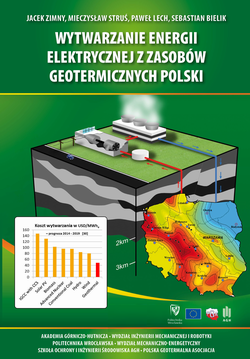
The monograph is the first Polish utilitarian scientific book of a comprehensive assessment of the production of electricity and heat energy in Poland from its own geothermal resources.
The book has evolved from the experience of the "Polish geotermal school" created by prof. Julian Sokołowski (AGH, PAN). An initiative comes from the cooperation between the Polish Geothermal Association (PGA) based in Cracow, the Faculty of Mechanical Engineering and Robotics of the AGH University of Science and Technology, the Department of Energy Systems and Equipment for Environmental Protection AGH (prof. Jacek Zimny et al) and the Faculty of Mechanical Engineering and Mechanics and Power of the Technical University of Wroclaw (col. assoc. prof. eng. Mieczysław Struś).
Contents:
Chapter 1 presents an evaluation of the condition of the power industry and power engineering within these areas.
Chapter 2 defines geothermal energy (from water, rock) as an ecological and most promising electric power and heat source on Earth in the 1st half of the 21st century (in EU and in Poland).
Chapter 3 comprises technological descriptions and mathematical models concerning basic energy technologies, geothermal power and heat generation systems used worldwide and in the European Union. It proposes energy technologies for the geological conditions of Poland.
Chapter 4 presents an evaluation of recommended geothermal electricity generation technologies in Poland (ORC, Karolina), while Chapter 5 comprises a detailed comparative analysis of Kalina cycle technologies for building 500-4000 kWe capacity heat and power plants. Energy balances for those power plants were also calculated in comparison with traditional power plants. Based on a comparative thermodynamic, technical, cost and ecological analysis, in Chapter 6 and 7 optimum options recommended for Polish conditions were presented.
Chapter 8 presents the kinds of conclusions (theoretical, empirical and concerning future prospects).
Chapter 9 includes a vast bibliography concerning the topic
Chapter 10 comprises appendixes which constitute an important supplement to the contents of the paper.
A book wil be available since January 2015.
|